
Written by: Ben Adams | October 13, 2026 |
Marketing reports one CAC, finance rebuilds it from the ledger and gets another, and you’re the one explaining the gap upward. This post is for CMOs, VPs of marketing and founders in that spot. Customer acquisition cost (CAC) is the total cost of winning one new customer. Customer lifetime value (LTV) is the gross margin a customer brings in over the time they stay. Here’s how to calculate CAC and LTV so marketing and finance land on one number: agree on four definitions first, then do the math from them.
The short version
- Marketing and finance report different CAC and LTV figures because each team works from its own definition of a cost and a customer.
- Agree four definitions with finance before any math: blended or paid CAC for each report, the fully loaded cost list, cohort-based LTV, and the date the payback clock starts.
- CAC is the agreed costs for a period divided by the new customers signed in that period.
- Cohort LTV is the gross margin a cohort earns over the agreed window, divided by every customer who started in it, including the ones who left.
- Read the LTV to CAC ratio and CAC payback period together, and record any change to a definition in the next report.
Why do marketing and finance report different CAC numbers?
They report different numbers because each team has settled, usually without saying so, on its own definition of what counts as a cost and what counts as a customer.
Where the same data produces two different answers
Marketing tends to start from ad spend and the customers those ads produced, because that’s what the ad platforms and analytics tools report. Finance starts from the ledger and divides every salary, commission, software invoice and agency fee by every new customer the business signed. Each is accurate for its own question. The trouble starts when two different questions get reported under one name. Andreessen Horowitz lists failing to include all the costs of acquiring customers, “such as referral fees, credits, or discounts,” as a common problem with CAC metrics.
LTV splits in a similar way. One report multiplies an average revenue per customer by an assumed churn rate and projects a lifetime. Another follows the customers who signed in the same month and counts the margin they’ve actually earned. Payback splits on timing, because one team starts counting at the signed contract and another at the first invoice. Put those side by side in a leadership meeting and someone will reasonably ask which one is true.
What changes once both teams use the same definitions
Disagreements turn into line-by-line checks. When both teams work from the same written definitions, a gap between two figures points to one specific input: a cost moved, a cohort behaved differently, or a contract signed later than expected. Finance traces the number to the ledger and you trace it to the pipeline, so the report you carry upward stops needing a footnote. You ask what changed, and that tells you where next quarter’s budget should go.
Which four definitions should marketing and finance agree on first?
The four are blended or paid CAC for each report, the costs that go into it, the way you group customers for LTV, and the date payback starts counting. Bring all four to one meeting, in this order, because each builds on the one before.
Blended or paid CAC: which one each report carries
Pick blended or paid for each report, and print the name next to the number every time.
Blended CAC spreads acquisition cost across every new customer, including the ones who arrived through organic search, referrals and word of mouth. Paid CAC counts only your paid-channel spend and the customers who came to you through those channels.
Use blended CAC in board and finance reports, because it shows whether growth is sustainable across every channel. Use paid CAC in the channel review, where the question is whether the next dollar of paid spend earns its keep. A report that says only “CAC” is the one that starts the argument.
Fully loaded costs: the cost list both teams sign off on
Fully loaded customer acquisition cost carries the full cost of acquiring a customer, and the cost list is the page both teams sign.
The principle is simple: if the business wouldn’t have spent the money without trying to win customers, it belongs in the number. The debate happens at the edges, with shared tools, people who split their time and allocated overhead. Settle each one with finance by name, once, in writing. The line items are in the first question at the end of this post.
Leaving a cost out makes CAC look better for a quarter. It looks worse the first time finance rebuilds the number from the ledger. Agreeing the list up front gives you a CAC that holds up under a check.
Cohort-based LTV: grouping customers by when they signed
Group customers by the period they signed, and define customer lifetime value as the gross margin each group earns per customer.
Everyone who signed in March is one cohort, everyone who signed in April is another, and so on. Each cohort has its own revenue history: what it paid, when customers left and whether accounts grew. A company-wide average blends old cohorts with new ones and can hide the fact that they behave differently. Cohorts show it, and finance can tie each one to billing records.
For young cohorts, agree on a fixed window, such as 12 or 24 months of actual results, and label anything projected beyond it as projected. Agree on the margin too. Gross margin is the usual choice, and if finance prefers a margin that also subtracts fulfillment and payment costs, put that on the page so both teams use it.
Payback period: when the clock starts and which margin it uses
Payback period is how many months a cohort’s gross margin needs to cover what it cost to win that cohort. Two choices to settle: when the clock starts, and which margin it runs on.
I’d start the clock on the date the customer signs. It’s a date both teams can verify in the contract record, and it keeps payback tied to the same moment CAC is measured. If finance prefers a different start, such as the first invoice, that works as long as every report uses it.
Run payback on gross margin. Revenue includes money that goes straight to serving the customer, and that money isn’t available to repay anything. The formula is in the last question below.
How to calculate CAC and LTV once the definitions are set
Once the definitions are agreed, CAC is the period’s costs divided by the new customers signed, and LTV is a cohort’s gross margin divided by the customers who started in it, so finance can trace every input.
Write each formula in words on the shared page, and keep the same inputs and the same period every month.
Calculating blended CAC
Blended CAC is everything you spent to win customers in a period, divided by every new customer you signed in that period.
Add up every cost on the signed cost list for the period. Count every new customer signed in that same period, whichever channel brought them in. Divide the first figure by the second.
Both inputs should tie to a system finance already trusts: the cost total to the ledger and the customer count to billing or the customer relationship management (CRM) system. If your sales cycle runs several months, agree whether costs are matched to the period they were spent in or to the customers they eventually produced, and write down which.
Calculating paid CAC
Paid CAC is the cost of paid channels for a period divided by the new customers those channels produced in that period.
Add up the paid-channel cost, count the new customers credited to paid channels, and divide. State whether the paid cost is media only or also includes the agency fees, creative and tools behind those channels. Either works when it’s labeled and used the same way every month.
Which customers count as paid depends on how customers are credited to channels. That’s a separate question, covered in marketing mix modeling vs attribution. For this calculation, agree one crediting rule with finance and apply it in every report.
Calculating cohort-based LTV
Cohort LTV is the gross margin a cohort earned over the agreed window divided by the number of customers who started in that cohort.
Pull each customer’s revenue by month from billing, subtract the cost of serving them to get gross margin, and add it up across the window. Divide by the customers who started in the cohort, including the ones who left. Dividing by survivors only would leave out the customers who churned and overstate LTV.
Do this for each cohort and keep the results side by side, so you can see whether newer cohorts earn more or less than older ones.
How do the LTV to CAC ratio and CAC payback period work together?
LTV to CAC shows how many times over a cohort repays its acquisition cost across the agreed window, and CAC payback period shows how long it takes to repay it once. You need both to judge a cohort.
The ratio is LTV divided by CAC, with both taken from the same cohort and built on the definitions you agreed. If LTV uses gross margin, CAC should use the fully loaded cost list, so the ratio compares like with like.
Each number can look fine while the other points to a problem. A high ratio with a long payback strains cash. A short payback with a thin ratio means customers repay quickly and then leave.
The card below runs one cohort through all four calculations.
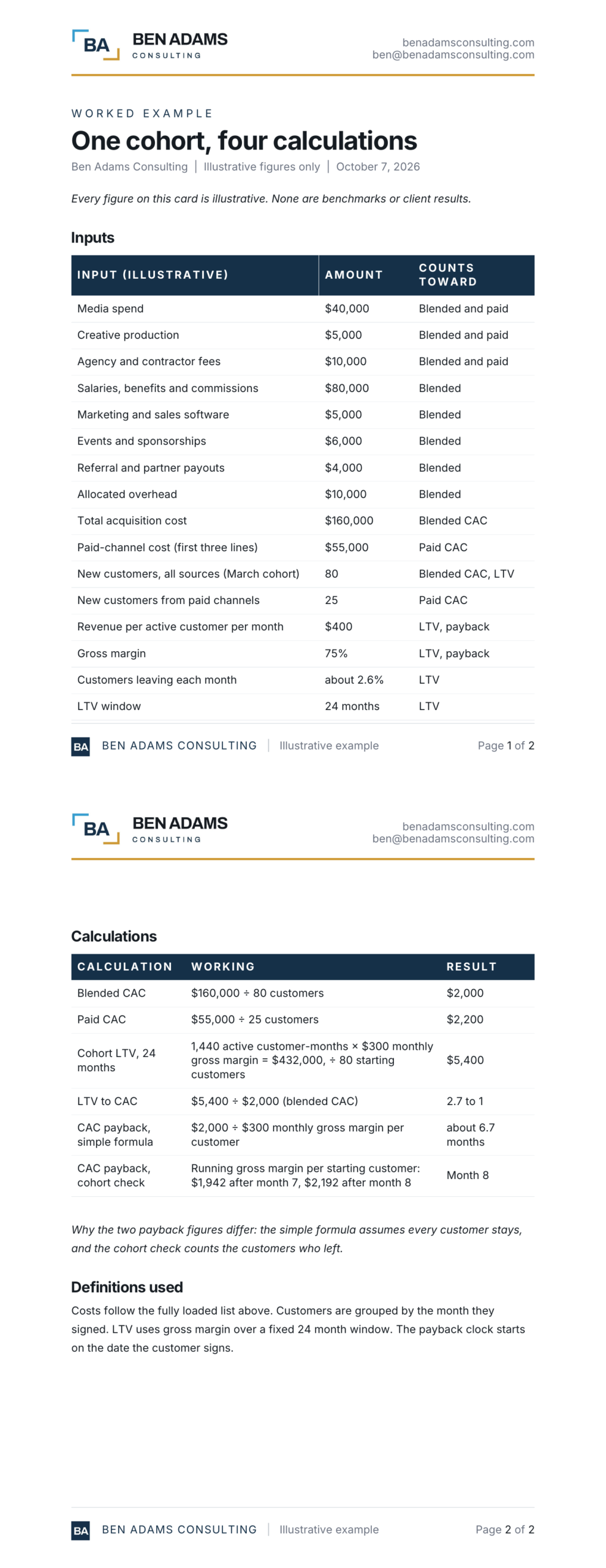
Worked example: one cohort, four calculations
Every figure on this card is illustrative. None are benchmarks or client results.
| Input (illustrative) | Amount | Counts toward |
|---|---|---|
| Media spend | $40,000 | Blended and paid |
| Creative production | $5,000 | Blended and paid |
| Agency and contractor fees | $10,000 | Blended and paid |
| Salaries, benefits and commissions | $80,000 | Blended |
| Marketing and sales software | $5,000 | Blended |
| Events and sponsorships | $6,000 | Blended |
| Referral and partner payouts | $4,000 | Blended |
| Allocated overhead | $10,000 | Blended |
| Total acquisition cost | $160,000 | Blended CAC |
| Paid-channel cost (first three lines) | $55,000 | Paid CAC |
| New customers, all sources (March cohort) | 80 | Blended CAC, LTV |
| New customers from paid channels | 25 | Paid CAC |
| Revenue per active customer per month | $400 | LTV, payback |
| Gross margin | 75% | LTV, payback |
| Customers leaving each month | about 2.6% | LTV |
| LTV window | 24 months | LTV |
| Calculation | Working | Result |
|---|---|---|
| Blended CAC | $160,000 ÷ 80 customers | $2,000 |
| Paid CAC | $55,000 ÷ 25 customers | $2,200 |
| Cohort LTV, 24 months | 1,440 active customer-months × $300 monthly gross margin = $432,000, ÷ 80 starting customers | $5,400 |
| LTV to CAC | $5,400 ÷ $2,000 (blended CAC) | 2.7 to 1 |
| CAC payback, simple formula | $2,000 ÷ $300 monthly gross margin per customer | about 6.7 months |
| CAC payback, cohort check | Running gross margin per starting customer: $1,942 after month 7, $2,192 after month 8 | Month 8 |
Why the two payback figures differ: the simple formula assumes every customer stays, and the cohort check counts the customers who left.
How do you keep the numbers trusted after the first report?
Write the definitions on one page both teams sign, and change any of them only when both teams agree and the next report says what changed.
Record the definitions on one page both teams sign
The page holds the four definitions: which CAC each report carries, the cost list, the cohort grouping and window, and the payback start and margin. Next to each one, name the person who owns the data behind it, so a question about a number goes to one place.
The monthly report built from that page needs an owner too. The cleanest setup is one person who owns analytics and reporting, publishes the same report in the same format every month and answers for the number. That’s what lets leadership trust a trend line without re-checking it.
Change a definition only with both teams, and say so in the next report
Definitions will need to change. A new tool joins the cost list, or a cohort rule gets tightened. Make the change in a meeting with both teams, update the page, and say what changed in the next report. Show the old and new figures for one period side by side, so nobody mistakes the step in the trend line for a real shift in performance.
Questions I get asked
What costs belong in CAC?
Every cost of winning a customer belongs in CAC. A fully loaded list covers:
- Media spend on every channel you pay for
- Creative production for those channels
- Marketing and sales salaries, benefits and commissions
- Agency and contractor fees
- Marketing and sales software
- Events and sponsorships
- Referral and partner payouts
- Allocated overhead, using an allocation method finance approves
Two items are finance’s call, so put the answer on the signed list: credits and discounts offered to win a customer, and customer success time spent on renewals and expansion. How any of these are booked in the accounts is finance’s decision. The point for CAC is that both teams count the same list.
What is a good LTV to CAC ratio?
A good ratio is one your company can afford, and that depends on your gross margin and on how long you can wait for payback.
LTV is built from margin, so a thin gross margin leaves less to repay acquisition cost after serving the customer. David Skok writes in SaaS Metrics 2.0 (updated June 2026) that the best SaaS businesses run an LTV to CAC ratio higher than 3, and that profitability turns anemic once recovering CAC takes longer than 12 months. I’d read them as a floor to test against your own margin and cash position. Set the target with finance from those two inputs, then hold every cohort to it.
How do you calculate CAC payback period?
CAC payback period is CAC divided by the gross margin a customer earns each month, and the answer is in months from the date the customer signs.
- Take the cohort’s CAC, using the cost list and the CAC type both teams agreed.
- Work out gross margin per customer per month: average monthly revenue per customer times the gross margin percentage.
- Divide the cohort’s CAC by that monthly gross margin. The result is the payback period in months.
When customers leave early, check the result against the cohort itself. Add up the gross margin per starting customer month by month from the signing date, and payback is the first month the running total reaches CAC. That version uses real retention, so finance can verify it against billing.
Once finance and marketing agree on how to calculate CAC and LTV, the reporting gets faster and the conversation moves to decisions. Let’s talk about your CAC, LTV and payback reporting.