
Written by: Ben Adams | October 16, 2026 |
Organic visits are climbing on the dashboard, and the pipeline report hasn’t moved. If you carry a pipeline target and someone has asked you to show what SEO adds to it, this post is for you, whether you run marketing, lead a small team or own the business. A B2B SEO strategy is a plan for which pages your site needs, and in what order, so buyers researching a purchase find you and those visits turn into pipeline. Here’s how I build one, starting from the revenue number and ending with the keyword list.
The short version
- Start from the revenue target, and agree the share of pipeline organic search should carry with whoever owns that number.
- Find topics in sales calls, lost deals and customer questions, and tag each with the buying stage it serves.
- Give each topic one page, matched to its stage.
- Name one owner per page, and measure each page against the job its stage asks of it.
- Build the keyword list last, and keep the entire plan on one page.
What a B2B SEO strategy built around pipeline looks like
It starts with the revenue the business needs and works back to the topics, pages and proof buyers need at each stage of a purchase. The keyword list comes last. Because every page traces back to a share of the pipeline target, you can explain why each one exists.
Why a plan that starts from keywords stalls in B2B
A keyword list sorted by search volume rewards traffic. In SEO for B2B companies, the buyers who matter are few, several people weigh in on each decision, and they research for a long time before they talk to anyone. The phrases with the most searches are often the ones your buyers use least, so traffic and pipeline drift apart.
There’s an accountability problem too. When leadership asks what the program added to pipeline, a keyword-first plan has no good answer, because nobody tied the pages to the number when they were planned.
The five parts of the plan: revenue target, topics, pages, owners, measures
A B2B SEO plan has five parts, and I build them in this order:
- Revenue target: the number the business has to hit, and the share of pipeline organic search will carry toward it.
- Topics: the questions buyers research at each stage of a purchase.
- Pages: the page on your site that answers each topic.
- Owners: one named person responsible for each page.
- Measures: how each page is judged, based on the stage it serves.
Keywords come after all five are in place, attached to the pages they belong to.
Step 1: Start from the revenue target
Begin with the revenue number the business has committed to for the planning cycle, and turn it into the pipeline you need to reach it. That pipeline figure is what the SEO plan answers to.
How to set the pipeline share organic search has to carry
Set the share by comparing the pipeline you need with what organic search supports today and what new pages could reasonably add. Use your own win rate and average deal size to work out how much pipeline the revenue target requires. Then look at how much of today’s pipeline organic search already supports. The share you set sits between what it carries now and what the planned pages could add over the cycle.
Write it down as a share of the pipeline target. If the pages you can realistically build won’t carry it, the plan grows or the share comes down, and you want that settled before anything gets built.
Agree that share with whoever owns the revenue number
Take the share to the person who owns the revenue target, whether that’s the CEO, the head of sales or you as the owner, and agree to it before the plan goes further. That sets what SEO is responsible for, so organic search isn’t later judged against the entire pipeline.
It also brings the other channels into the conversation, because whatever organic search doesn’t carry has to come from somewhere else. If the owner thinks the share is too low, ask which channel will make up the difference. Either way, you leave with a figure you both signed up for.
Step 2: Work back to the topics buyers research at each stage
With the share agreed, list the questions buyers research on the way to a purchase, then sort them by stage. Most of the raw material is already inside your company.
Find topics in sales calls, lost deals and customer questions
Listen to recorded sales calls, or sit in on a few. Read the notes on deals you lost, because a lost deal often points to a question your site never answered. Ask the people who onboard new customers what those customers wish they’d known earlier.
Write each question in the buyer’s own words. A buyer who asks how to stop quoting freight from spreadsheets is describing a topic, even if they never name your product category.
If you sell software, the content map built from your product’s use cases is a second source of topics. That’s a separate exercise, specific to SaaS SEO, and it sits outside this plan.
Tag each topic with the buying stage it serves
Give every topic one stage tag: defining the problem (what’s going wrong and what it costs), comparing approaches (which way to solve it) or choosing a vendor (who to buy from).
Each stage needs a different kind of page and a different measure, so Steps 3 and 4 depend on these tags. A topic that seems to fit two stages is usually two topics.
Build the B2B keyword strategy last, from the topics
Your B2B keyword strategy comes from the topic list, once every topic has a stage. For each topic, find the phrase buyers use when they search for it, and check it against the words they used on sales calls. Pick one primary phrase per topic and a few close variants. If two topics share a phrase, they’ll compete with each other in search, so merge them or separate them.
Step 3: Decide which page earns each topic
Give each topic one page, and choose the type of page by the stage the topic serves. Buyers selecting a vendor need a service page, and buyers still defining the problem need a post or a guide.
Service pages for buyers who are selecting a vendor
A buyer at the vendor stage wants to know what you do, who it’s for and whether you can deliver. Those topics belong on service pages, because that’s where a buyer who’s ready can act. If a vendor-stage topic has no service page to land on, that gap goes near the top of the build list.
Posts and guides for buyers who are still defining the problem
Problem-stage and comparison topics belong in posts and guides. These readers aren’t ready to select anyone, and a sales pitch will lose them. What earns their attention is a clear explanation of the problem, what causes it and the ways to solve it, including approaches you don’t sell. Each post should point to the next step a reader would take, usually a deeper guide or the related service page.
The proof each page needs before a buyer will act
Every page needs proof matched to its stage, because buyers won’t act on a claim they can’t check. On a service page, that means named results, an approved client testimonial, a description of how the work runs and a plain statement of who the service is for. On a post or guide, the proof is showing you understand the problem: the mechanism behind it and a method the reader can follow.
List the proof each page needs beside it in the plan. If the proof doesn’t exist yet, the page waits until someone collects it. Whoever builds and owns the pages needs the topic, its stage and its proof before writing starts. When there’s nobody in-house to do that, it’s the work I take on in SEO and AI search engagements.
Step 4: Give every page an owner and a measure
Assign each page one named owner and one measure tied to its stage. The measure shows whether the page is doing its part, and the owner acts when it slips.
One named owner per page
Each page gets one person’s name, never a team’s. The owner keeps the page current, updates its proof when new results come in and answers for it when its measure moves. A page nobody owns drifts out of date, and buyers notice.
Measure each page against the stage it serves
Judge each page by the job its stage gives it. A problem-stage post and a vendor-stage page do different work, so they shouldn’t be held to the same number. For a vendor-stage page, the measure is how many sales conversations it starts. For a post or guide, it’s whether readers move on to the next stage: a deeper guide, a service page or a sign-up that keeps them in touch. Hold a problem-stage post to sales conversations and it will look like a failure even while it’s doing its job.
Where SEO sits next to your other channels
SEO is one contributor to a pipeline number that’s owned across channels, alongside paid media, account-based marketing and email. The share you agreed to in Step 1 is SEO’s part of that number, and the plan works best when the channels share topics and proof.
My work with 3G, a transportation management software company, shows how this plays out. It was a four-year integrated program across positioning, SEO, paid search, account-based marketing, analytics and automation, carried through a website migration and a rebrand. The program produced 25% more leads for 3G. SEO was one part of it, and the result belongs to the program. Jake Tomberlin, Marketing Director at 3G, described it this way:
“Using a combination of SEO, content marketing and paid media, we grew leads to the website by 25%, which grew pipeline and sales. Ben also guided us through a website migration and a rebranding without giving back the ground we had gained. It positioned the company to be purchased, which was the intended outcome.”
Keep the B2B SEO plan on one page
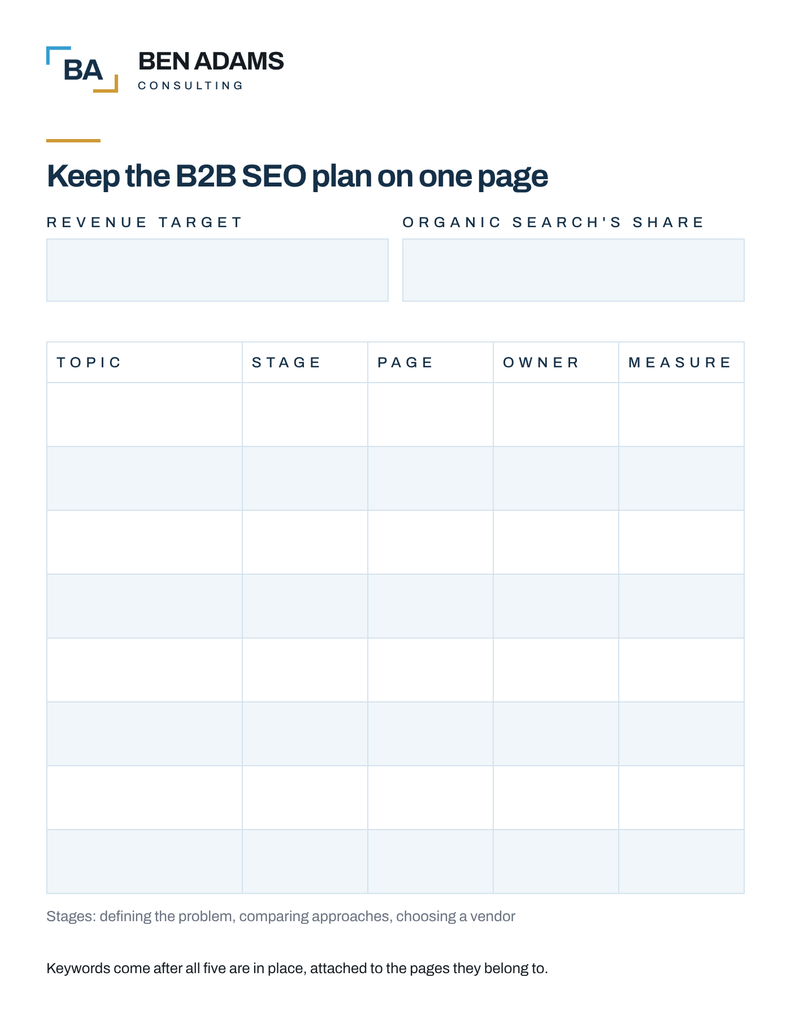
Put the entire B2B SEO plan on a single page: the revenue target and organic search’s share at the top, then one row per topic with its stage, its page, the page’s owner and its measure.
Use it to decide what gets built first: sort the rows by how much each page adds toward the agreed share and how much of it already exists, then start with the pages that add the most for the least amount of new work. Update the same sheet as pages go live, so it always shows what’s built, who owns it and how each page is doing against its measure.
Questions I get asked
What is B2B SEO?
B2B SEO is search engine optimization for companies that sell to other businesses, so buyers researching a purchase find your pages and trust what they read. What changes in B2B is the buyer. There are fewer of them, they research for longer, and several people are usually involved in each decision, so your pages have to answer different questions for different people.
How do I connect SEO to pipeline?
Track organic visits through to opportunities in your customer relationship management (CRM) system. When someone arrives from organic search and later fills in a form or books a call, record organic search as the source on their contact record, so it stays with them when they become part of an opportunity. You can then see which opportunities include an organic visit and which pages those visits landed on.
Should I target bottom-of-funnel keywords first?
Order the work by what the pipeline share needs. Often that means buying-stage pages come first, because they’re closest to a sales conversation. Research-stage topics still belong in the plan, though. Buyers who first find you while defining the problem may come back when they’re ready to choose, and without those pages, the buying-stage pages have fewer people to convert.
How do I report SEO results to leadership?
Report pipeline against the target the same way every month, with organic search shown as one source inside it. Start with where total pipeline stands against the target, then show organic search’s contribution next to the share you agreed. Keeping the format identical every month lets leadership read the trend without first working out what changed in the report.
A B2B SEO strategy built this way starts with the revenue target and ends with the keyword list, with topics, pages, owners and measures in between. Every page earns its place by the share of pipeline it supports, so you can show leadership why it’s there.
Let’s talk about building an SEO plan against your own pipeline number.