
Written by: Ben Adams | October 30, 2026 |
Your attribution report gives the month’s credit to paid search or direct traffic, and then the buyers you talk to say they first heard about you from a colleague, a podcast or an AI search answer. If you report marketing results each month for a B2B company or a DTC brand, this post compares software attribution with self-reported attribution, the source a buyer names when you ask how they found you, and shows how to collect those answers in a form you can count. My view is that tracking software can only credit what it can follow, so the sources it can’t follow have to come from buyers, and buyer answers only become usable once they’re collected and coded the same way every time. I don’t sell attribution software or a survey product; I set up attribution and collect buyer-reported sources as part of the analytics and reporting work in my marketing leadership and retained specialty engagements. I also built attribution and reporting across a 22-brand portfolio.
The short version
- Software credits what it can tie to a visit, so demand that starts earlier lands on direct traffic or branded search.
- Private sharing, AI search answers and word of mouth leave no source the software can follow.
- Self-reported attribution fills those gaps once answers are collected and coded the same way every month.
- Keep a free-text field on every form. A short dropdown is optional and always includes AI search and “Other.”
- Trust the software for what happened after the first visit, and trust buyers for where demand started.
What software attribution records, and where it goes blind
Software attribution records the touches it can tie to a visit on your site, and it goes blind to anything that happens before that visit. Three sources fall into that gap most often: private sharing, AI search answers and word of mouth.
What tracking software can see
Tracking software sees clicks, tagged links, ad clicks and the sessions that follow them: which campaign brought a visitor in, which pages they read and when they converted.
What it can’t see is anything before the first tracked visit. If a buyer heard about you somewhere the software can’t follow, then later typed your address or searched your name, the credit goes to the last thing the software saw. That’s usually direct traffic or a branded search. How credit gets split among the touches the software does see is a question of measurement model choice, and I’m leaving it out of this post.
Dark social: sharing the tracking can’t follow
Dark social is sharing that happens in private: links and recommendations passed along in direct messages, group chats, online communities and forwarded emails. Those visits arrive with no source attached, so they usually show up as direct traffic. Dark social attribution is the work of finding out what’s sitting inside that direct number.
In B2B, a buyer drops a link to your product page into a team chat while the vendor shortlist takes shape, and colleagues visit from it. In DTC, a shopper sends a product link to a friend in a private message, and the friend buys later. Either way, the software records direct visits and nothing about the conversation that sent them.
AI search: answers that name you without a click
A buyer can read an AI search answer that names your company, close it without clicking and visit later by typing your name or searching for it. The software credits that later visit, and the answer that introduced you never shows up. If you want to track how often that happens, I’ve laid out a method for counting AI search mentions.
Word of mouth: the recommendation nobody tagged
Word of mouth is a colleague, a peer or a friend naming your company in conversation. There’s no link and no click, so there’s nothing for the software to record, and it never appears as a source unless you ask the buyer.
What self-reported attribution captures
Self-reported attribution captures where the buyer says they first heard about you, in their own words. That’s often a channel the software never saw, so it gives you a direct record of the private shares, AI search answers and recommendations that started the interest.
The source the buyer remembers
When you ask, the buyer names what brought you to their attention: a podcast episode, a post a peer shared, an answer from an AI assistant, a recommendation over lunch. Each of those answers adds a source that click tracking had no way to record.
Where to ask: a B2B form and a DTC checkout
Ask where buyers already hand over information.
For a B2B company, the “How did you hear about us?” field sits on the demo or contact form. Sales can add context from the first call, when a buyer often explains the fuller story behind a one-line answer.
For a DTC brand, the question is a one-question post-purchase survey shown right after checkout. The order is already placed, so the question doesn’t get in the way of the sale, and each answer ties a source to a specific order.
How to structure the “How did you hear about us?” field so you can count it
Structure the field so every answer can be coded into a reporting channel and counted the same way each month. In practice that comes down to four steps:
- Ask once, where buyers already raise their hand.
- Build any option list from the channels you report.
- Code every free-text answer into a channel.
- Count it the same way every month.
Ask once, where buyers already raise their hand
Put one question on the form or checkout page the buyer already completes, so nobody has to fill out anything extra. A separate form or a follow-up email asks for more effort at the moment the buyer has the least reason to give it.
Keep the wording identical everywhere the question appears. If the demo form asks “How did you hear about us?” and the contact form asks “What brought you here today?”, you’re collecting two different answers, and you can’t add them up as one.
Build the option list from the channels you report
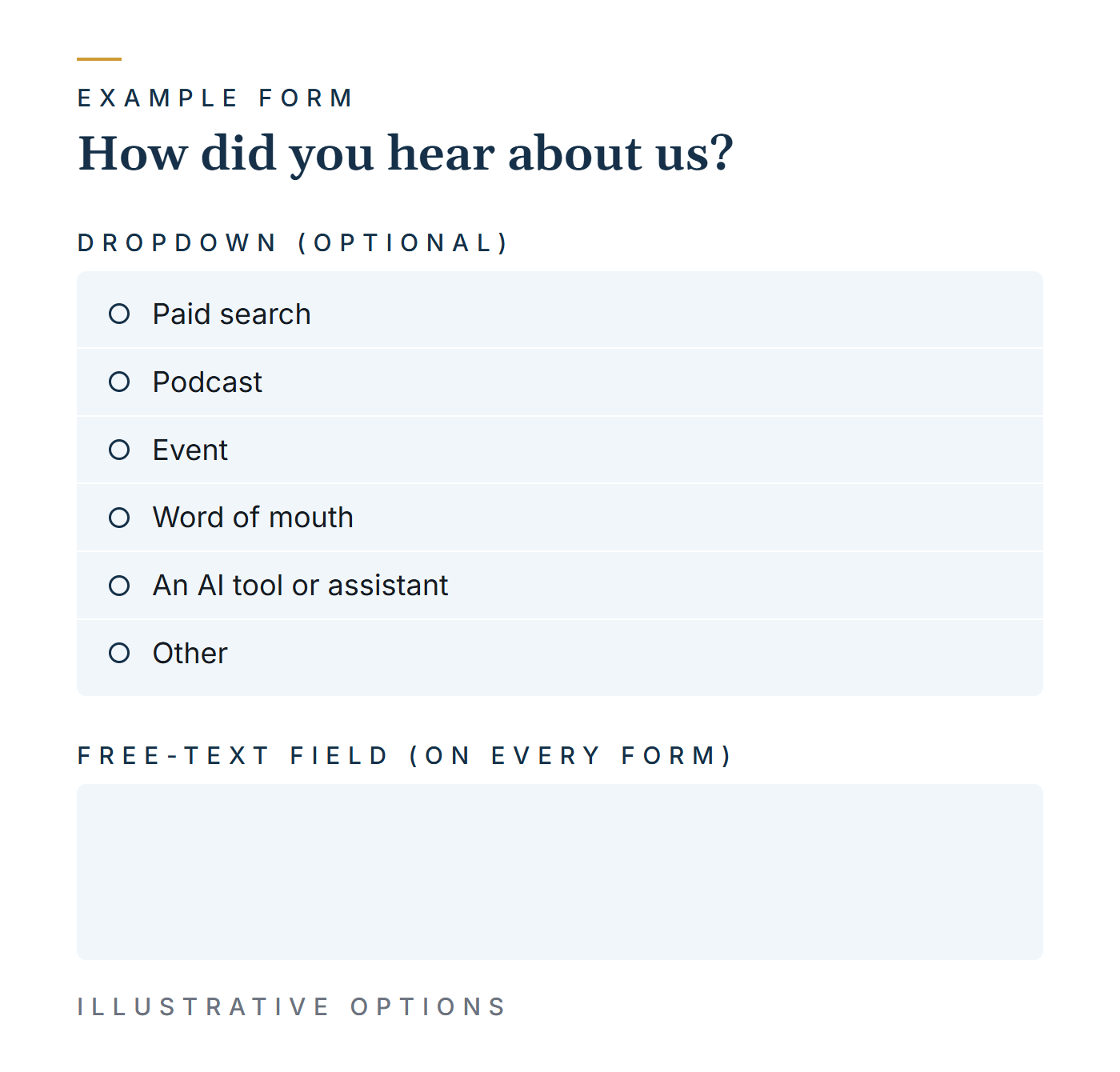
If your form uses a dropdown, its options should match the channels already on your monthly report, plus an AI search option and an “Other” option. The free-text field sits next to it on every form.
Matching the list to your report means each selection drops straight into a channel you already track. The AI search option, worded the way buyers say it (an AI tool or assistant), gives those answers somewhere to land, and “Other” catches what the list missed, with the free-text field explaining it. The example form below shows the layout, with illustrative options.
Code every free-text answer into a channel
Keep a short coding list that maps the words buyers write to one reporting channel. A podcast name goes to podcasts. “A friend” or “my colleague” goes to word of mouth. The name of an AI tool, or “I asked AI,” goes to AI search.
Apply the same rules every month, so a count in March means the same thing as a count in April. When an answer fits no channel, add a new row to the coding list and decide once where it belongs. A guess made differently each month quietly changes your numbers.
Count it the same way every month
At the end of each month, tally the coded answers by channel. Use the same form, the same question wording and the same coding list each time, so the trend can be read from one month to the next. If you change any of them, note the month you made the change, because the counts before and after won’t compare cleanly.
When to trust each source
Trust the software for what happened after a buyer’s first tracked visit, and trust the buyer for where demand started. The reporting question in front of you decides which one to use.
Trust the software for what happened after the first visit
Once a buyer is on your site, the software is the better witness. It records which campaign, page or path a tracked visit took before it converted, and when each step happened. When leadership asks which landing page converts best, or whether a campaign is producing demo requests or orders, answer from the software.
Trust the buyer for where demand started
For the channels that create awareness the software can’t see, buyers are the only source. Private sharing, AI search, recommendations, podcasts and events all start interest without leaving a click behind. When leadership asks whether a podcast appearance or an event is bringing in new buyers, the coded answers are where you’ll find out.
Read a disagreement as a signal
When the software credits direct traffic or branded search and buyers name a channel the software can’t see, the gap shows you where untracked channels are doing work. Report it as a finding, with the channels buyers named. Leave both numbers as they are, and don’t adjust either one to make them match.
Questions I get asked
Is self-reported attribution accurate?
It’s accurate enough to count the sources your software can’t see, read as a trend over several months. Buyers tend to remember the touch that stood out, often the most recent or the most personal one, some answers are vague, and some buyers skip the question. So I use it as a count of untracked sources over time, and I don’t use it to assign precise credit for any single deal or order.
Should the field be a dropdown or free text?
Keep a free-text field on every form, because a fixed list only offers the options your team thought of. A short dropdown is an optional extra that makes coding faster, as long as its list carries an AI search option and an “Other” option. If the form only has room for one, use free text.
How do you combine self-reported and software attribution?
Hybrid attribution, reading the software data and the buyer answers together, works best as two separate columns on the same monthly report, under the same channel names. Don’t add the columns together or blend them into one number, because they count different things. Then add a short note each month on where the two disagree.
Software attribution tells you what happened once a buyer reached your site, and self-reported attribution tells you where the interest started. Once the question is asked the same way and the answers are coded into your reporting channels each month, both can sit on one report.
Let’s talk about putting buyer-reported sources beside your attribution report.